
Leon County Scheduled Versus Actual Release
A scheduled or tentative date is a forecast made while custody continues. An actual release date records an event that has happened. Florida Department of Corrections records may use several labels, including Tentative Release Date, Current Release Date, Maximum Sentence Expiration, Conditional Release, and a completed release date. Those labels are not synonyms. Copy the exact field name, status, and as-of date when documenting a Leon County state-prison case.
The distinction is just as important at the Leon County Detention Facility. A sentenced person may have a scheduled day, yet the jail handbook says release can occur at any time on that day. Other releases begin after written legal authority reaches the facility. Court or clerk paperwork, another agency's hold, and final wants checks can delay or redirect the exit. The jail's completed out-processing event is therefore stronger evidence than a spoken court ruling, a bond receipt, or a future calendar date.
A pretrial detainee is different. There is no sentence to reduce through gain-time. Release turns on bond, recognizance, supervised pretrial release, a court order, dismissal, or another written authority. Even then, a transfer to another jail, FDC, federal custody, treatment, or a state hospital is not community release.
Find a Leon County Projected Date
Start by identifying who now holds the person. Leon County cases can move between the county jail, an FDC prison, an FDC community release center, and a federal facility. Each uses a separate record. The FDC Corrections Offender Network is the proper state route, while the LCSO inmate search is limited to people currently in county custody.
- Establish the custodian. Use the court docket, current roster, or known transfer record to decide whether the person is in LCDF, FDC, or federal custody.
- For an FDC sentence, open Inmate Release Information Search. Use the six-character DC number when available, or search by first and last name and compare the full identity.
- Read the exact date label. A record may cover someone already released or someone only scheduled for release. Do not convert a future result into a completed event.
- For an LCDF sentence, obtain the commitment and calculation. Ask LCSO for the projected date and the eventual release event, and compare the court judgment and jail credit.
- Confirm close to the date. Other sentences, credits, discipline, holds, and new court action can change what was shown earlier.
The official FDC Inmate Release Search shows why the DC number and correct population matter. It covers people sentenced to Florida prison or state supervision, not people sentenced only to Leon County jail or county probation.
View the source page used for the FDC release-search image.
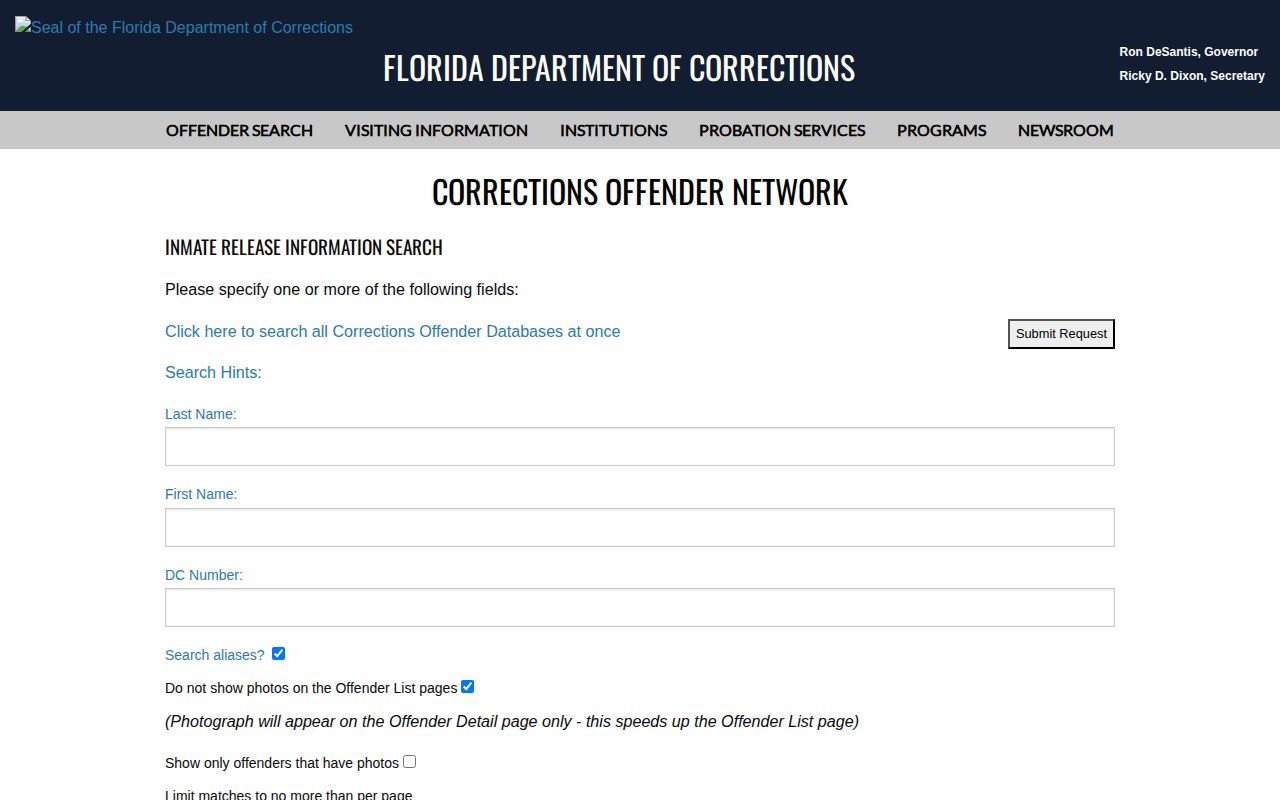
The form accepts a DC number, name, aliases, and photo options, so a result must be matched by more than name alone.
Note: FDC reports nightly updates for release-search data, but a live agency response remains stronger when timing is urgent.
Florida Tentative Release Date Rules
Florida law calls the state-prison calculation a tentative release date, often shortened to TRD. Under Florida Statute §944.275, FDC first establishes a maximum sentence expiration date after lawful jail and prison credit. It then maintains the tentative date by applying gain-time authorized for the sentence and offense-date cohort. Restored or newly awarded gain-time can move the date earlier. Forfeited gain-time can move it later.
For relevant offenses committed on or after October 1, 1995, the statute permits up to ten days per month of incentive gain-time, subject to the law tied to the offense date and statutory exclusions. Specified murder, kidnapping, sexual, lewd or lascivious, and related offenses are excluded within stated cohorts. One rate cannot be applied to every old and new sentence. Additional terms, corrected jail credit, escape time, and violations may also force FDC to recalculate.
The official tentative-release and gain-time statute is shown below.
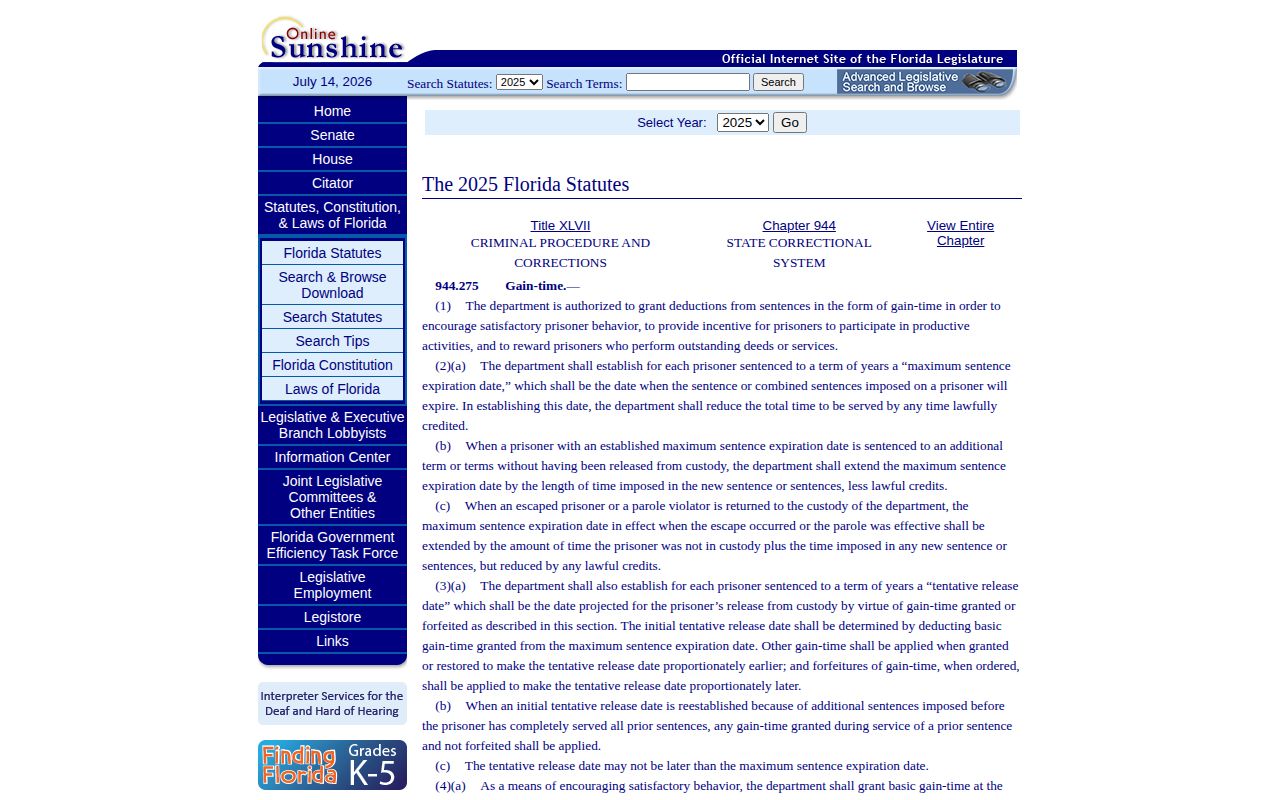
The statute supplies the legal framework, while FDC's own calculation controls the date for a specific Leon County commitment.
Leon County Truth-in-Sentencing Floor
Gain-time has a firm limit for the covered modern cohort. Section 944.275(4)(f) prevents gain-time from producing release before at least 85 percent of the imposed sentence has been served. Court-awarded credit for physical incarceration counts toward that floor. Florida Statute §921.002 repeats the 85-percent truth-in-sentencing policy for Criminal Punishment Code cases.
This is not a public date calculator. The imposed sentence, offense date, each credit, concurrent or consecutive terms, exclusions, and later adjustments all matter. Once the statutory floor is reached, ordinary gain-time cannot push the date earlier. A life sentence is not turned into a calendar date through 85-percent arithmetic.
Note: Parole applies mainly to eligible legacy cases and limited cohorts, so it should not be assumed from sentence length alone.
Leon County Jail Date Calculation
The state-prison TRD rules do not govern a county-jail sentence as though LCDF were an FDC institution. Section 921.161 addresses credit for time already spent in county jail. Section 951.21 authorizes county prisoner gain-time under local administration. Leon Detention Court Services works from the court commitment, applicable credit, lawful local rules, and other holds.
Use the Leon Clerk's judgment and sentence to establish the legal term. Then ask LCSO for the calculation and, after the date passes, the actual release event. A court docket may explain the authority, but it may not record the moment out-processing finished. LCSO's releasing office can address a same-day operational question at 850-606-3526. A durable answer comes from the booking and release record.
- Jail credit
- Time in physical custody credited by the court toward the sentence.
- Gain-time
- A lawful reduction administered under the rules that apply to the sentence and custodian.
- Detainer or hold
- A request or legal basis for another agency to take or continue custody.
- Discharge
- Completion of the relevant correctional term, which is different from transfer.
What Changes Leon County Release Dates
A projected date can change for more than one reason. The source of the change also tells the reader which office can verify it. FDC controls a state-prison calculation, the court controls sentence and credit orders, and LCSO completes the county jail release event.
| Factor | Possible effect | Best confirmation |
|---|---|---|
| Gain-time award or restoration | May move an eligible FDC tentative date earlier | FDC release detail or calculation record |
| Gain-time forfeiture or violation | May move the tentative date later | FDC record and related action |
| Corrected jail credit | Can alter the maximum and tentative calculations | Court order plus custodian calculation |
| New or additional sentence | May extend or restructure custody | Judgment, sentence, and FDC or LCSO record |
| Another-agency hold | May delay community exit or cause transfer | Release event with public transfer destination |
| Parole or conditional-release action | May affect the release framework or supervision | FCOR final order and FDC status |
A parole hearing agenda only shows that a matter was scheduled. It does not prove a grant, denial, or completed release. For an eligible legacy case, obtain the final Florida Commission on Offender Review action and compare it with FDC's release and supervision records.
Read Leon County Release Date Fields
FDC maintains separate search populations because a sentence can move through incarceration, release, and supervision. The Inmate Release Information Search contains people who have already been released as well as people scheduled for release. That mixed scope makes the status and date relationship essential. A future result belongs in the projected category even when the page name includes the word “release.”
| Official field or source | What it can establish | What it cannot establish alone |
|---|---|---|
| Tentative Release Date | FDC's calculated state-prison projection under applicable law and credit | That the person physically left custody |
| Maximum Sentence Expiration | The maximum endpoint established from the sentence and lawful credit | The likely earlier date after all applicable gain-time |
| Current Release Date | The date carrying that exact label in the current detail | Another date field with a different legal meaning |
| Conditional Release | A correctional status tied to the relevant statutory framework | Unsupervised completion of all control |
| Completed release record | An FDC release event reflected after it occurred | That no other sovereign or supervision authority remains |
| Supervised Population | Reported type, status, office, location, and termination information | Current prison custody or an LCDF sentence |
FDC reports different update cycles for these populations. Inmate release data updates nightly. Current inmate population data refreshes weekly except that release dates and location changes update nightly. Supervised and absconder information also refreshes weekly except termination dates and location changes, which update nightly. Those cadences can explain a short mismatch between a new court action and the public display, but they do not authorize guessing which record is newer.
If a state detail is inaccurate, FDC directs classification and central-record questions to 850-488-9859. The Bureau of Admission and Release handles substantive release questions at 850-488-9167 or dc.release@fdc.myflorida.com. A focused public-record request can ask for the tentative-date calculation, maximum expiration, release action, or supervision termination by DC number and date range.
Leon County Pretrial Release Has No TRD
A person held at LCDF before disposition does not have a state-prison tentative release date to calculate. The court may authorize bond, recognizance, or Leon County Supervised Pretrial Release. The local program places an officer in LCDF around the clock and attends First Appearance every day of the year. A judge may impose curfew, testing, treatment, electronic monitoring, or other terms.
That event is release before the criminal case is resolved, not sentence completion. It should be verified through the court order, local pretrial office, and LCSO's completed event. If the person later receives a county jail or FDC sentence, the correct calculation starts with that later judgment. Mixing the pretrial order with a prison TRD would collapse two different stages of the case.
A hold can still change the result. LCSO checks wants and other-agency authority during release processing. The court may authorize release in the Leon case while another jurisdiction receives custody. The record must show whether the person entered the community or was transferred.
Note: Bond eligibility or a pretrial order supplies legal authority, while the jail event records when and how LCDF custody actually ended.
Confirm a Leon County Release
Near the expected day, compare the current custodian's record with any court action. For LCDF, ask whether the person is still in custody and later request the actual date, time, method or authority, and transfer destination if public. For an FDC case, compare Inmate Release Information with Supervised Population when community control may follow prison. A release from prison can begin probation, conditional release, or another supervision status rather than end all correctional control.
Florida VINE can provide a tentative date and event alert from a participating agency. The separate VINELink Check explains how to select the right Leon County custodian and read release versus transfer wording. VINE is secondary status evidence, not a permanent certified discharge record. If the person disappears from a search, request the underlying record rather than treating absence as proof.
The Leon County release-record workflow on the home search is the correct next step after the date passes. It distinguishes release into the community from movement to FDC, another county, federal custody, treatment, or another placement. That distinction closes the gap between an estimated day and what actually happened.