
Leon County Parole Versus Probation
Probation is a court-ordered community sentence or part of a sentence. Parole is conditional community release authorized through the Florida Commission on Offender Review for a legally eligible prison sentence. Florida abolished ordinary parole for most modern felony cohorts, so the word should not be used as a broad label for every person who leaves prison. FDC Community Corrections supervises state probation and other state community statuses. FCOR makes parole and certain conditional-release decisions.
Leon County also runs supervised pretrial release and county probation. Pretrial release places a defendant in the community before the criminal case is resolved. County probation follows a local court order and may not appear in FDC’s statewide felony supervision search. The order and docket identify which office has authority.
| Status | Who creates it | Where to verify |
|---|---|---|
| State probation | Florida court sentence | FDC Supervised Population and assigned circuit office |
| County probation | Leon County court order | Leon Clerk docket and County Probation |
| Supervised pretrial release | Judge before case disposition | Release order and Leon Pretrial Release |
| Parole | FCOR for an eligible sentence | Final FCOR action plus FDC supervision record |
| Conditional release | Statutory and FCOR/FDC process | FCOR order and FDC record |
- Parole
- Conditional release from prison for a legally eligible sentence, with supervision in the community.
- Probation
- A court-ordered community status with conditions instead of, or following, confinement.
- Discharge
- The formal end of a custody or supervision term as shown in the controlling record.
- Absconder
- A supervised person whom FDC says has stopped making themselves available for supervision.
Verify Leon County Release Supervision
Begin with identity and the legal source. A jail roster can confirm current confinement, but it does not establish what supervision follows release. The Leon Clerk docket may contain the pretrial order, probation sentence, later violation, or termination. For a Florida state case, the six-character DC number is the best key because it follows the person through FDC’s release and supervision systems.
- Read the Leon criminal docket for the exact status: pretrial release, county probation, state probation, parole, or conditional release.
- For state supervision, open the FDC Supervised Population Search and use the DC number when available.
- Compare name, photograph, supervision type, status, office or location, and public termination information. Do not select by name alone.
- Contact the listed FDC office when the public result is unclear or appears stale.
- For local supervision, call the Leon pretrial or county probation unit named by the court order.
- If a parole calendar is involved, obtain the final FCOR action rather than treating an agenda as the result.
FDC says supervised-population data is refreshed weekly, while termination dates and location changes update nightly. A recent court action can therefore precede a public update. The official state search screen shows the correct source for released people under FDC control.
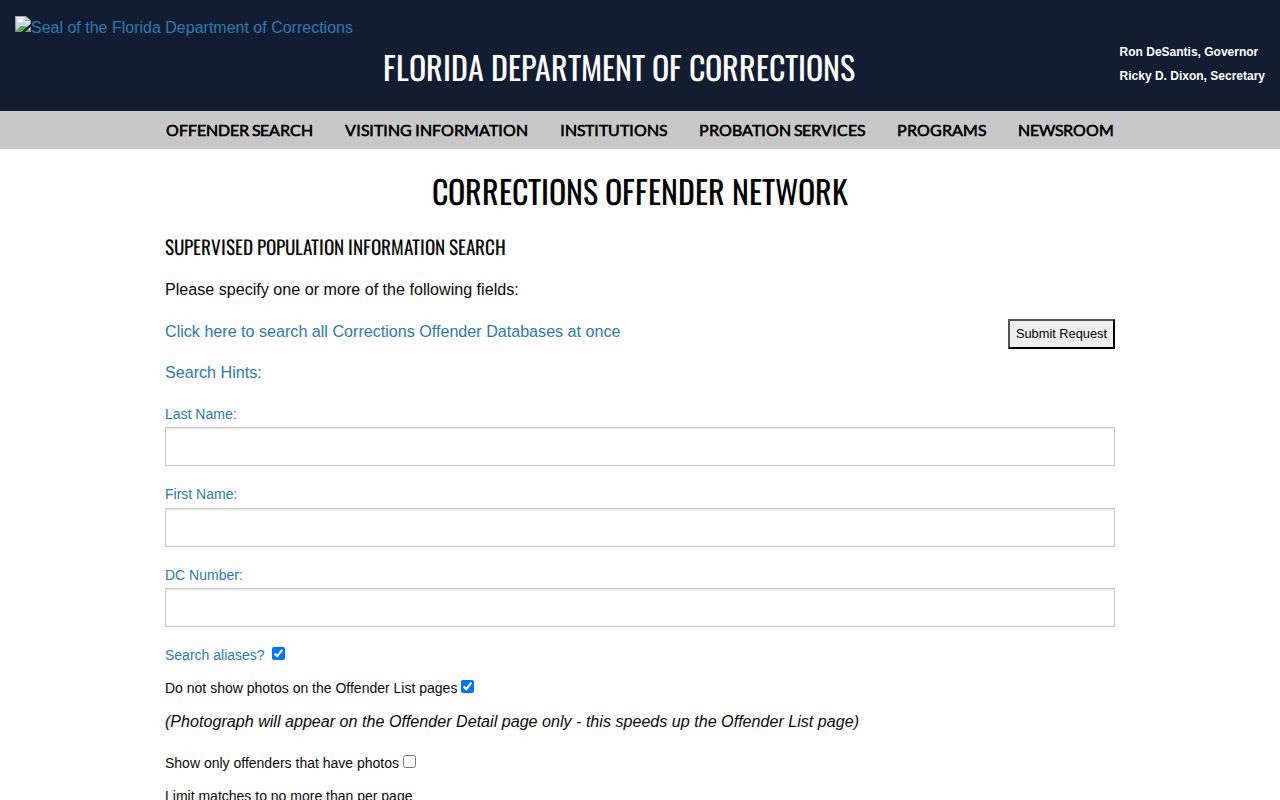
A matching entry means the person is outside prison under the listed state supervision, not that all correctional obligations have ended.
Note: A recent court action can precede the next public FDC update, so confirm close questions with the assigned office.
Leon County Supervision Offices
Office selection follows the record. FDC’s Tallahassee Circuit Office administers Circuit 02 state supervision. Leon County Intervention and Detention Alternatives handles local pretrial release and county probation. A person can live in Leon County yet report to another office if the official record assigns a different location, so confirm the current entry before visiting.
FDC Tallahassee Intake
1815 South Gadsden Street
Tallahassee, FL
850-488-3596
FDC Tallahassee Main
1958 Commonwealth Lane
Tallahassee, FL
850-487-6509
Leon Pretrial and Probation
501 Appleyard Drive
Tallahassee, FL
Monday through Friday, 8 a.m. to 5 p.m.
Pretrial: 850-606-5700
County Probation: 850-606-5600
The official FDC Tallahassee Circuit Office page identifies the state offices and contact numbers.
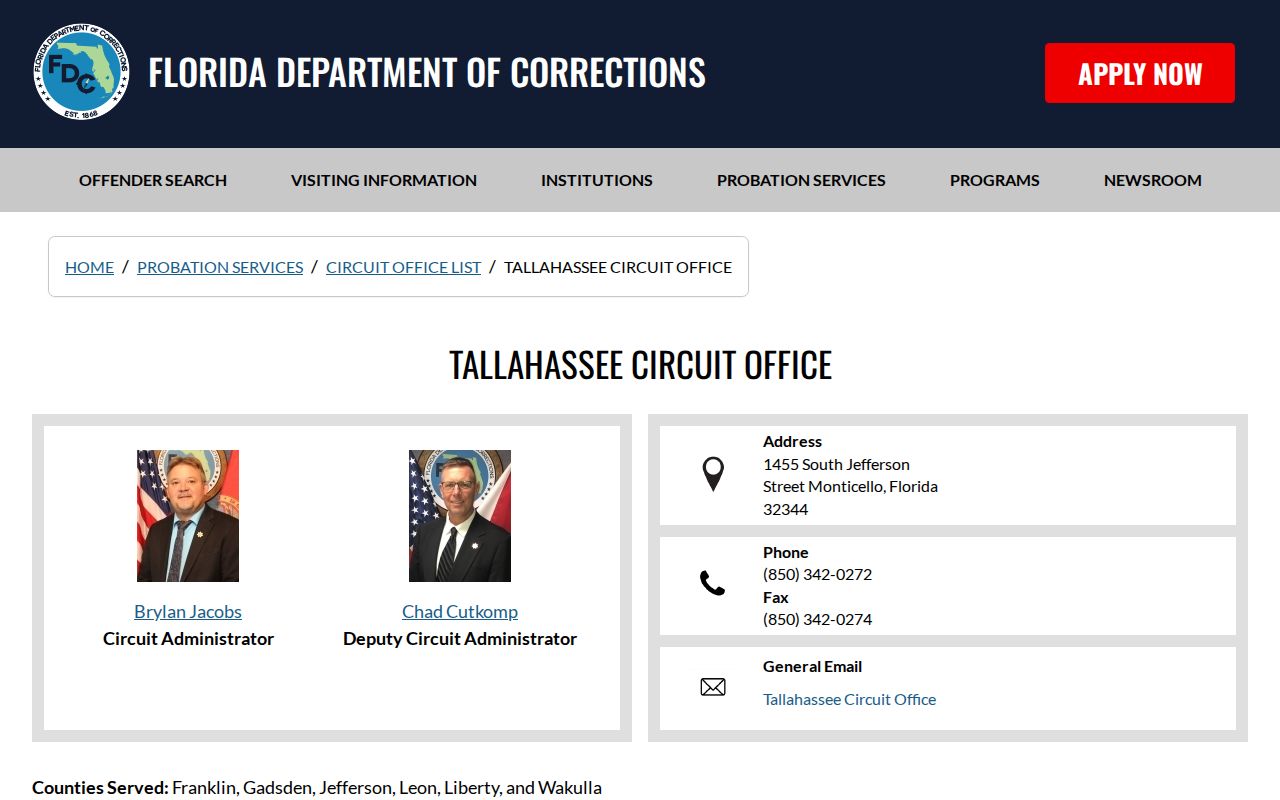
For county supervision, the local court order remains the best way to distinguish pretrial reporting from county probation.
Note: An office address in an old order may change, so confirm the currently assigned location before travel.
Leon County Violations and Absconders
Conditions come from the sentence, release order, or supervising authority. They may concern reporting, curfew, location, treatment, tests, registration, or electronic monitoring. LCSO’s Releasing Section coordinates GPS attachment with probation or parole when applicable. This local step can occur before the person physically leaves LCDF.
FDC maintains a separate Absconder/Fugitive Search for people who have stopped making themselves available for state supervision. Use that database when the question concerns state reporting status. Silence in the ordinary supervised search is not enough to declare a violation, discharge, or warrant. The FDC Absconder Unit is available at 850-717-3475 on weekdays from 8 a.m. to 5 p.m.; urgent location information belongs with law enforcement.
LCSO’s public felony warrant list has its own limits. It excludes warrants older than five years and those issued in the prior two months. It is not a complete warrant-clearance source and cannot replace the FDC absconder database or a court record.
Leon County Parole Decision Records
The Florida Commission on Offender Review publishes a voting schedule and dated agendas. An agenda can show the hearing date, name, DC number, category, county, offense, case number, and panel. It proves that a matter was scheduled. It does not prove parole was granted, denied, deferred, or changed.
When the final result is not posted, request the written vote or order through FCOR Public Records. Give the name, DC number, and hearing date, then compare the final action with FDC’s release and supervision record. FCOR accepts public-record requests without requiring a written form and invoices applicable charges before copies are processed.
Eligibility depends on offense date and sentence. Section 921.002 applies Florida’s Criminal Punishment Code to covered felonies committed on or after October 1, 1998 and states that Chapter 947 parole does not apply to those code sentences. Legacy and other statutory cohorts require a case-specific review. Under §§947.16, 947.172, and 947.174, interviews, a presumptive parole release date, and later reviews are decision stages, not proof that custody ended.
Note: A scheduled FCOR hearing or presumptive date does not establish that parole was granted or release occurred.
When Leon County Supervision Ends
Completion must appear in the record controlled by the supervising authority. For state probation or another FDC status, check the public termination information and request the underlying record if the date or action needs durable confirmation. A final FCOR order matters for parole. County probation and supervised pretrial release end through the local court or program process shown in the Leon docket.
A release date and a supervision termination date answer different questions. The first marks the end of confinement by a custodian. The second marks the end of the listed community control. A person may be released from LCDF, enter local pretrial supervision, later receive probation, and only then reach final discharge. The complete custody and release path is set out on the Leon County released inmates record page.
Florida VINE can provide custody and event notifications, including release, transfer, work-release placement, return to custody, and death. It does not replace a final discharge record. FDC Victim Services enrollment is also separate from direct VINELink registration.
Leon County Release Notifications
LCSO’s Florida VINE information confirms that the statewide service covers LCDF, all Florida county detention facilities, FDC prisons, and DJJ. It can report current location and tentative release information and accept registrations for release, transfer, escape, work-release placement, movement to another jurisdiction, return to FDC custody, and death. Those events concern custody. They do not establish that probation or parole ended, and a transfer must not be read as entry into the community.
The published telephone workflow operates around the clock at 1-877-846-3435. A caller registers with a four-digit PIN. When a call is missed or the line is busy, VINE retries every 30 minutes for up to 48 hours. A voicemail does not stop those calls. Entering the PIN followed by the pound sign confirms receipt, and each registered telephone number has its own PIN. Event timing can still lag the originating agency, so the supervising office and final order remain the sources for discharge.
FDC Victim Services uses a separate agency enrollment for release, transfer, escape, death, and out-to-court notices. Direct VINELink registration does not automatically create that FDC record. FDC Victim Services can be reached at 1-877-884-2846 on weekdays from 8 a.m. to 5 p.m. Eastern. Keeping the two registration paths distinct helps preserve alerts without confusing a custody update with completion of Leon County post-release supervision.
Note: A VINE release alert confirms an agency-fed custody event, not the final termination of probation, parole, or conditional release.
RISE After Leon County Release
The LCSO RISE Center is distinctive because it serves people released from four systems: LCDF, FDC, DJJ, and BOP. Its case-manager and one-stop model can help with identification documents, legal and health access, treatment links, financial counseling, and family reunification. The current number is 850-606-3172.
RISE support does not determine whether a person is on parole or probation. The court order, FDC record, or FCOR action still controls that answer. The program can, however, help a released person navigate practical needs that may overlap with a supervision plan.
Note: RISE can help with practical navigation, while the supervising agency remains the authority for reporting duties and discharge.
Property After Leon County Release
LCDF returns personal property during out-processing. The LCDF inmate handbook says $5 is given in cash and the remaining commissary balance is placed on a debit card, with a check used if the card system is unavailable. Transfer procedures may differ. These steps close the jail account but do not show that probation, parole, or pretrial supervision ended.
A pre-release property authorization takes about 24 hours to reach the Property Office. The person collecting property should call first and bring photo identification. The authorization becomes void after 30 days. Keeping property pickup separate from the supervision lookup prevents an administrative handoff from being mistaken for proof of discharge.