
Leon Juvenile Departure Boundaries
Leon Regional Juvenile Detention Center is a secure Florida Department of Juvenile Justice facility. It is not the Leon County adult jail, an FDC prison, or a federal institution. Youth may be held while awaiting adjudication, disposition, or placement following a commitment decision.
A departure can mean return to a parent or guardian, transfer to a program, movement to another detention setting, or court-ordered supervision. These outcomes cannot all be called release into the community. The court order and DJJ record control the status, while the person lawfully responsible for the youth receives information under the applicable confidentiality rules.
Adult LCSO and FDC searches are inappropriate for exposing youth identities or trying to build a release list. An adult roster miss is not evidence about a juvenile case. No public names, photographs, case details, or departure dates should be published merely because the center appears in the Leon County facility map.
Authorized Leon Juvenile Verification
There is no public adult-style lookup workflow for youth departures. The proper route begins with authority to receive the information. A parent or legal guardian, counsel, or another person recognized by the court or DJJ should use the contact linked to the youth's case.
- Confirm the relationship or legal authority that permits access to the youth's information.
- Contact counsel or the juvenile court for the controlling detention, placement, release, or supervision order.
- Contact Leon Regional Juvenile Detention Center or DJJ using the official facility page and current instructions.
- Ask whether the youth returned to an authorized guardian, entered a court-ordered placement, transferred, or began supervision.
- Follow the receiving program or assigned DJJ office only when the authorized record identifies that destination.
This process protects the youth and prevents an adult record from being mistaken for a juvenile one. A shared name is not enough to connect an LCSO, FDC, or BOP record to a youth.
Note: Public-record access and family access are not the same; confidentiality may limit what can be disclosed to someone without legal authority.
Leon Juvenile Facility Contact
The official DJJ page provides the center's current public contact and identifies the counties it serves. Authorized parties should verify present procedures before arriving or sending records.
Leon Regional Juvenile Detention Center2303 Ronellis Drive
Tallahassee, FL 32310
Telephone: 850-488-7672
Florida Department of Juvenile Justice
The official DJJ facility page is shown below.
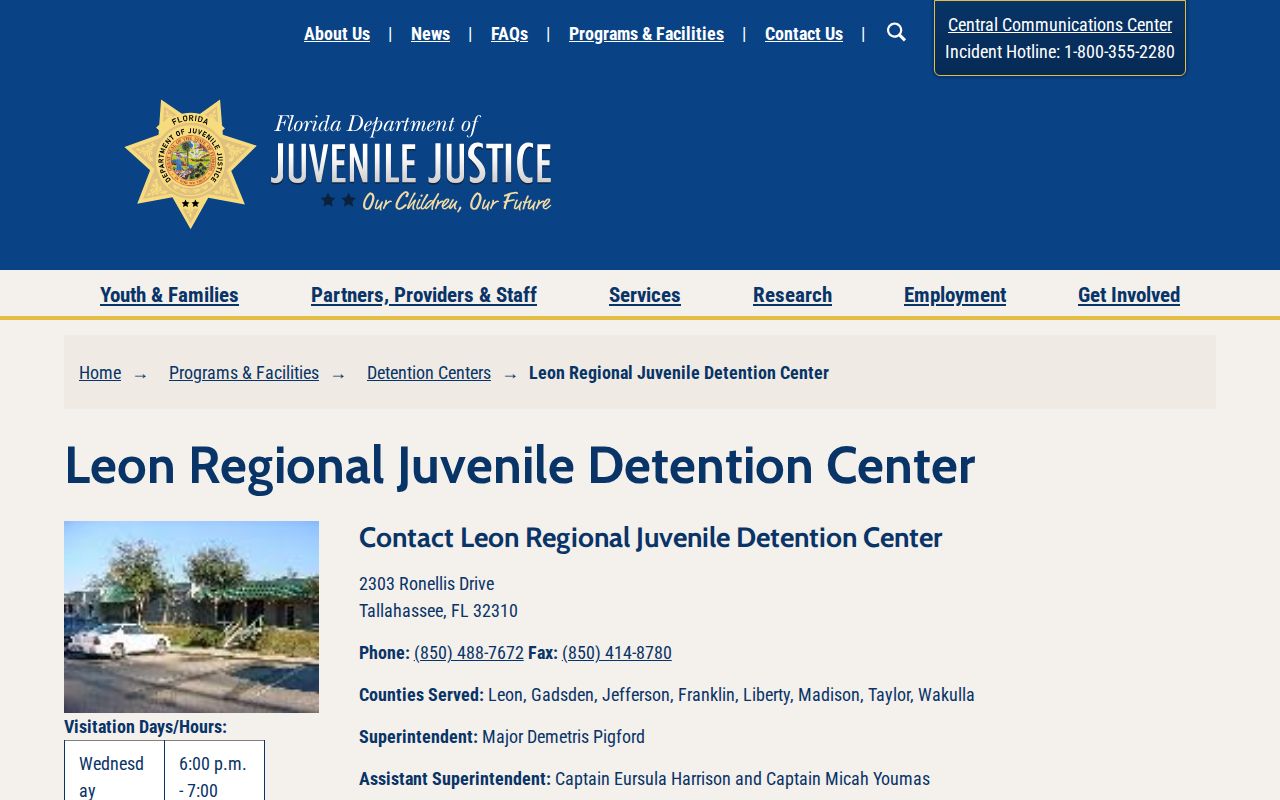
The source confirms the facility, its secure detention role, contact information, service area, and capacity without creating a public person-level lookup.
General calls should not include protected information beyond what is needed for routing. Counsel and the court can explain who may receive the record and what proof of identity or relationship is required.
Leon Juvenile Release Outcomes
Youth detention is tied to a juvenile proceeding. The court and DJJ can direct different outcomes based on the case stage and lawful order. The term “released inmate” is not an accurate label for every departure.
| Departure route | What it may mean | Authorized verification |
|---|---|---|
| Return to parent or guardian | Secure detention ends under the governing order | Court, facility, counsel, and authorized guardian |
| Placement in a DJJ program | Custody or court-ordered control continues in another setting | DJJ placement record and court order |
| Transfer to another detention center | Secure detention continues at a new site | DJJ and receiving center |
| Court-ordered supervision | Youth is in the community under juvenile justice conditions | Court order and assigned DJJ contact |
| Other authorized placement | Destination depends on the individual order | Counsel, court, and responsible agency |
The destination is essential. A facility departure may close one detention episode while the juvenile case, placement, or supervision continues.
Why Adult Leon Searches Do Not Apply
The LCSO current inmate search covers people currently held at the adult Leon County Detention Facility. FDC's public offender databases cover felony offenders sentenced to state prison or state supervision and expressly exclude county jail and county probation populations. Neither is a lawful substitute for confidential juvenile records.
The BOP locator covers federal records. It also has no role in ordinary DJJ detention. Searching all three adult systems and finding nothing does not prove that a youth was released, transferred, or never detained.
Florida VINELink materials state that statewide coverage includes DJJ as well as county detention and FDC. That does not make DJJ data public or merge the records. Any notification or status access must follow the eligibility and confidentiality rules for the individual youth and event.
Leon County's official VINE information page is the source shown below.
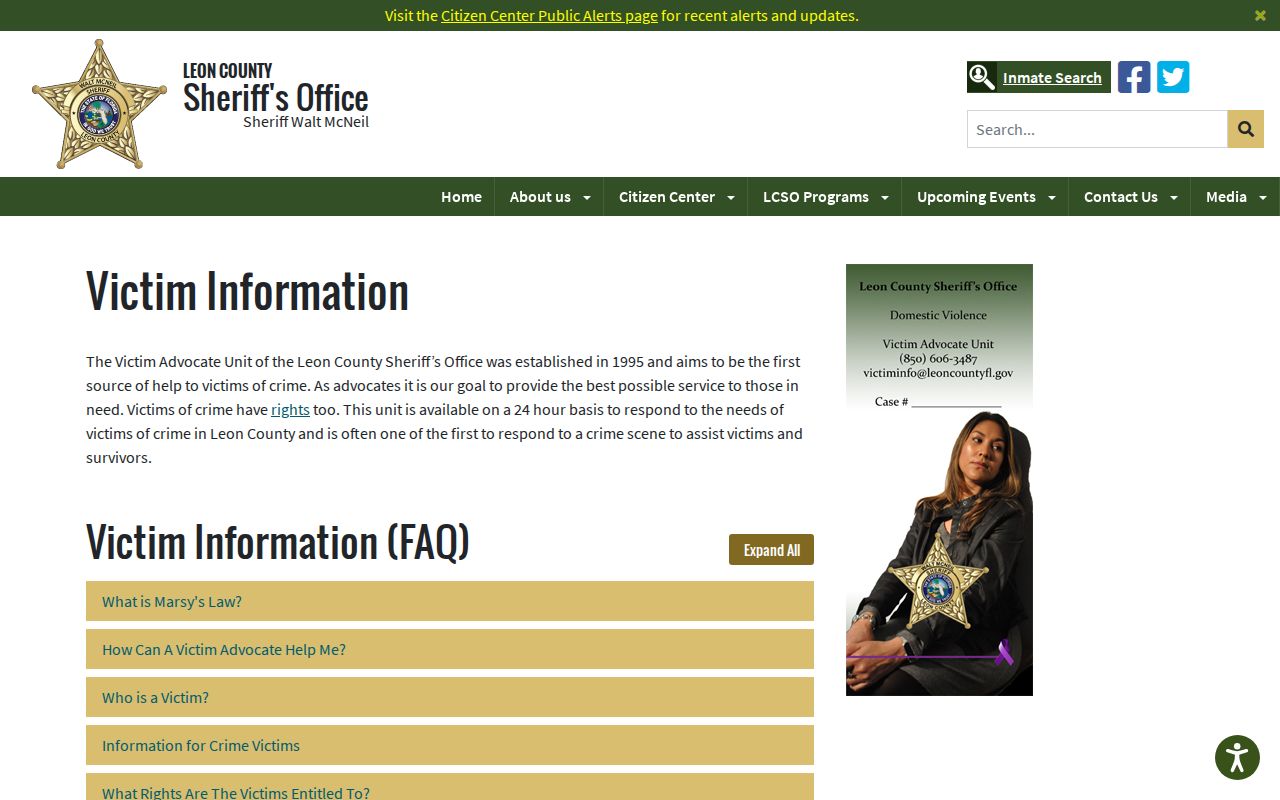
The source demonstrates statewide system breadth, but it does not authorize a public released-youth search or disclosure of confidential case information.
Leon Juvenile Court Records
Juvenile court information has confidentiality rules that differ from ordinary public adult criminal dockets. A court order may explain detention, adjudication, disposition, placement, return to a guardian, or supervision. Whether a particular filing can be inspected depends on the case, the requester's role, and the controlling law or order.
An authorized party should ask counsel or the clerk about the correct process and required identification. A broad public-record request does not override a confidential case status. Protected youth, victim, medical, education, treatment, and placement information should not be requested or published without lawful authority.
If an adult criminal search returns someone with the same name, do not use it to infer the youth's history. Date of birth and other identifying data may also be protected. The safe practice is to keep juvenile and adult records separate unless an authorized official record establishes the link.
- Adjudication
- The juvenile court's determination process; it is not an adult criminal conviction label.
- Disposition
- The juvenile court's ordered outcome following the relevant findings.
- Commitment placement
- A DJJ program or setting ordered for the youth, which can follow detention.
- Supervision
- Court-ordered community control administered through the juvenile justice system.
Leon Juvenile Records Requests
A request for a juvenile record should begin by identifying the precise record and the requester's authority. Useful identifying information may be provided directly to the authorized office, but it should not be posted in a public query or shared beyond the need for routing.
Ask the facility, DJJ, counsel, or juvenile court which office holds the detention event, court order, placement record, or supervision record. No single adult-style inmate file should be assumed. Each agency may hold a different part of the case and may apply a different lawful access test.
If access is denied, ask for the legal basis and whether a redacted or limited record can be provided to the authorized requester. Do not demand protected information about other youth, victims, family members, treatment, education, or facility security.
Record retention and confidentiality are separate. A record may exist but remain closed. A public search may show nothing even though an authorized record is retained. Absence online is not proof that the underlying event did not occur.
Note: A parent or guardian should follow current DJJ identity and authorization procedures rather than sending sensitive youth data through an unrelated portal.
Leon Juvenile Center Service Area
DJJ describes the center as serving Leon, Gadsden, Jefferson, Franklin, Liberty, Madison, Taylor, and Wakulla counties. It is a 45-bed hardware-secure facility. Those facts describe the facility's regional role and capacity, not the identity or status of any youth.
A youth from a neighboring county may be physically held in Leon while the court case and community destination belong elsewhere. The correct juvenile court, counsel, and DJJ office may therefore be outside Leon County. The service-area fact is a reason to confirm jurisdiction, not to infer residence or release destination.
Likewise, a transfer from the Leon center to another regional site continues detention. Return to a guardian may occur in another county. The record must identify the court and destination before an authorized party follows up.
About Leon Regional Juvenile Detention
The center holds youth awaiting adjudication, disposition, or commitment placement. Its hardware-secure classification describes a detention setting. It should not be described as an adult jail or state prison.
The facility is included in Leon County's custody map to show that not every detention site uses an adult release workflow. Its presence is a boundary marker. Public pages should explain the lawful route without posting names or inviting searches for a released-youth list.
For an authorized case question, begin with counsel, the juvenile court, the official DJJ facility contact, or the assigned DJJ office. Ask whether the youth returned to a guardian, transferred, entered placement, or began supervision. That direct, confidential process is the reliable alternative to an adult roster.