
Federal Detention Center Release Meaning
Federal Detention Center Tallahassee is a federal detention unit on the Capital Circle complex. Official BOP admission, orientation, and Tallahassee visiting materials identify the detention function separately from the low-security Federal Correctional Institution Tallahassee. The populations and release questions overlap, but they are not identical.
The detention unit principally serves people awaiting federal trial, sentencing, designation, or movement. A federal court release order may authorize entry into the community. USMS transport to another contract jail, the low-security institution, or another BOP facility continues custody. A sentence can also lead to transfer rather than release.
The phrase “left FDC Tallahassee” is therefore incomplete. Record the date, authority, and destination. A court order shows why release or detention was authorized. The transport or custody record shows whether the person actually entered the community or moved to a new custodian.
Confirm an FDC Tallahassee Release
No public USMS released-prisoner locator comparable to BOP was found. Confirmation requires a custody-specific sequence that begins with the federal case.
- Search the Northern District of Florida docket for detention, bond, release, sentencing, commitment, and transport-related entries.
- Use the BOP Inmate Locator when the person has a BOP record, preferably with the register number.
- Read Release Date and Location together. A current institution means custody continues; a future date is projected.
- Contact the Tallahassee federal clerk or USMS district office when the docket or locator does not resolve the event.
- Submit a focused USMS or BOP records request for the exact detention, release, or movement record.
- If another sovereign received custody, continue with its locator and do not report the handoff as community release.
The Leon County release search overview keeps the federal unit separate from LCDF, FDC state prisons, and juvenile detention. The local address does not make this an LCSO jail.
Note: A BOP locator result can include pretrial or other non-sentenced custody, so presence alone does not prove a conviction.
Federal Docket Release Authority
The federal docket is the best public source for the legal basis of detention and release. It may show an initial appearance, detention order, bond conditions, plea, judgment, sentence, revocation, or later modification. Read entries in sequence because an early release order may be stayed, changed, or followed by a new order.
The docket does not always show the physical departure time. A judge's action must reach the agencies responsible for detention and transport. Conditions may have to be satisfied before release. If USMS movement follows, the person may leave the unit without entering the community.
The Northern District of Florida Tallahassee courthouse is at 111 North Adams Street, Tallahassee. Its main number is 850-521-3501. The federal clerk can route docket and copy questions, while detention operations and prisoner movement belong to the appropriate agency.
- Detention order
- A court direction that authorizes custody while a federal matter proceeds.
- Release order
- A court direction allowing release under stated terms, subject to completion by the agencies involved.
- Designation
- BOP assignment of a sentenced person to an institution.
- Transfer
- Movement between custodians or facilities without community release.
BOP Search for FDC Tallahassee
The BOP locator searches by register, DCDC, FBI, or INS number, or by name with middle name, race, age, and sex refiners. Results show name, register number, age, race, sex, release date, and location. BOP says coverage generally extends from 1982 forward and updates daily.
A past date with “RELEASED,” no facility location, or “Not in BOP Custody” reports the end of BOP custody as reflected by the locator. It does not rule out supervised release, state or local custody, or immigration detention. A future date is projected. “UNKNOWN” means the term was not determined in the locator.
The official BOP Inmate Locator is shown below.
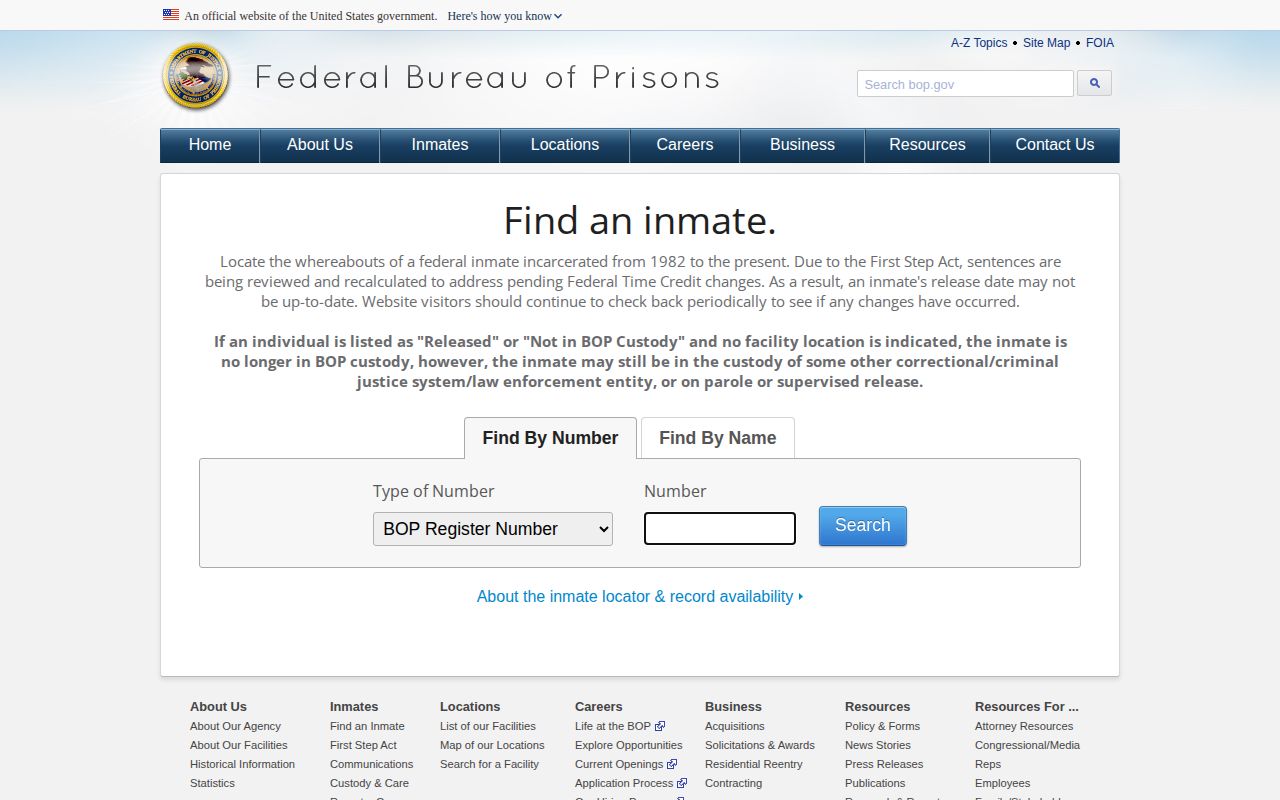
The locator can support a detention-unit check when a BOP record exists, but it does not replace the docket or USMS movement record.
FDC Tallahassee Contact Routes
The detention unit is on the same federal complex address as FCI Tallahassee. Official federal materials identify its separate detention role. Use current BOP sources before a visit because institutional access rules and unit routing can change.
Federal Detention Center Tallahassee501 Capital Circle NE
Tallahassee, FL 32301
Federal Bureau of Prisons complex
For USMS movement questions, the Northern District of Florida office is at 111 North Adams Street, Suite 277, Tallahassee, with telephone 850-404-5400. That office is distinct from the federal clerk, although both relate to the same district.
A request should identify the person, known register or case number, detention unit, approximate dates, and the specific record. Ask for an order, release event, movement record, destination, or booking photograph as separate items. Broad requests for an entire file are harder to process and may include protected material.
Note: Public contact information routes a request but does not authorize disclosure of sealed, protected, or Privacy Act material.
USMS Records for Tallahassee Detention
USMS manages federal pretrial prisoners and relies on federal, state, local, and private facilities. Many people in its custody are not held in a standalone USMS jail. That structure explains why no single public USMS roster tracks all current and released prisoners.
After conviction, USMS generally moves a sentenced person to BOP. Some short sentences may remain in USMS-arranged custody. Before judgment, the person can move between the Tallahassee unit and another contract facility. Each movement can remove the person from one location without ending federal detention.
USMS FOIA is the records route when no public locator resolves the event. The request must account for FOIA and Privacy Act limits and may require identity authorization. Ask for the narrow movement or release record and a public destination field, rather than assuming every part of a detainee file is open.
USMS booking photographs also go through FOIA and Privacy Act review. They should not be described as routine public images. A BOP locator result does not promise a mugshot.
Release and Transfer Outcomes Compared
Federal detention can end through several routes. The next record depends on the route shown by the docket or movement record.
| Outcome | Meaning | Best evidence |
|---|---|---|
| Court-ordered community release | Detention ends under federal conditions | Release order plus agency completion |
| USMS move to contract jail | Federal detention continues elsewhere | USMS movement record and receiving facility |
| Transfer to sentenced BOP custody | Institutional federal custody continues | Judgment, designation, and BOP locator |
| Release from BOP | BOP custody ends on reported date | Past locator date and released status |
| Transfer to state or local authority | Another sovereign takes custody | Federal movement and receiving record |
| Transfer to ICE | Immigration custody may continue | Movement record and ICE ODLS or ERO |
A single roster miss cannot distinguish these paths. The authority and destination must be joined to the date.
Other Custody After Federal Detention
ICE ODLS covers people currently in immigration custody or released from it within the prior 60 days, subject to omission, security limits, and upload delays. Search by A-number and name or by name, birth date, and country of origin. Juveniles do not appear. No result is not proof of release.
Florida state custody belongs in the FDC Corrections Offender Network. Leon County adult jail custody belongs in the LCSO current inmate search and records system. Neither should be used as a substitute for federal detention records, but each becomes relevant after a documented transfer.
Federal supervised release is another separate status. A person may leave detention or BOP custody under a court-ordered community term. The federal judgment and later docket entries control. The BOP locator is not a probation search and cannot establish that supervision ended.
About Federal Detention Center Tallahassee
The detention unit's principal purpose is federal pretrial, sentencing, and transfer custody. It should not be described as the low-security FCI population under a second name. Official BOP materials identify both functions at the complex.
That distinction changes the evidence. A sentenced FCI release often centers on a BOP release date. An FDC Tallahassee departure may require a court order, USMS movement record, BOP status, and receiving-custodian check. The unit's facility type makes the multi-record approach necessary.
No current public released-only feed exists for this detention unit. The federal docket, locator when applicable, agency contact, and focused records request form the honest chain. A person should be reported released only after the chain shows community release rather than continued custody elsewhere.