
Leon County Three-Day Feed Status
No official Leon County 72-hour released-only list was found in the sheriff's navigation, jail tools, app materials, records pages, or former booking-report path. The LCSO inmate search is expressly a current-custody tool. It does not promise that a released row remains online for three days, and its removal lag is not published.
A three-day roster difference is not a release list. Names can vanish because of transfer, corrected identity data, system timing, or movement to another custodian. Likewise, combining old Daily Booking Reports would not produce the missing list. Each report covered the people booked on that date, not all people released during it, and LCSO stopped posting those reports online and on social media in January 2025.
Build a Leon 72-Hour Window
The most accurate approach starts and ends with exact dates. Define the three calendar dates or timestamps needed. Then ask whether LCSO holds an existing commitment and release list for that interval. If no list exists, request the release events that match the same span or narrow the inquiry to named people. This keeps the request tied to records the agency can identify.
- Write down the start and end of the 72-hour period, including the local time and any weekend or holiday days.
- Check the LCSO roster only to learn who is currently listed at LCDF. Record the search time and spelling used.
- Call the releasing office at 850-606-3526 for an immediate operational question, or contact LCSO Records at 850-606-3317 for record access.
- Request an existing commitment and release list for the date range, or request named release events with actual timestamps, methods, and destinations.
- Match each event to the Leon Clerk docket and Florida VINE. Follow any transfer into the receiving state, federal, county, or immigration system.
The Leon County 24-Hour Release List method is better for a single same-day period. A 72-hour inquiry should not merely repeat that check three times because agency processing and weekends may cause records to arrive out of sequence.
Leon County Three-Day Release Fields
A complete response must identify each custody episode and its closing event. The retired report shows why familiar columns can mislead. It displayed a Last Release Date and In Jail? field, yet its population was a one-day booking cohort. For a true three-day inquiry, seek the fields from the underlying booking and release record.
| Requested field | How to read it |
|---|---|
| Name, SPN, booking number | Distinguishes people with similar names and separates multiple custody episodes. |
| Booking date | Shows when the episode began, even when booking occurred before the 72-hour window. |
| Actual release date and time | Determines whether the completed LCDF exit falls within the chosen interval. |
| Release method or authority | Explains bond, recognizance, pretrial release, fine or purge payment, time served, or another basis. |
| Transfer indicator and destination | Separates a community release from continued custody under another agency. |
| Charges and case numbers | Connects the event to court orders and the long-lived criminal case record. |
Current LCSO results can include photo, identity and age, last arrest, last release, In Jail?, charges, arresting agency, and detail. Those fields describe the current search result and may refer to more than one episode. They do not establish that everyone released during the prior three days stays visible.
Note: A release date without the method and destination can hide a transfer, so request all three when the distinction matters.
Leon Weekend Release Timing
A three-day span is useful when a search begins after a weekend, but no official source promises a special Leon weekend-release list. LCDF says sentenced releases may occur at any time on the scheduled date. Other releases begin after staff receive written authority. The usual out-processing estimate is about 45 to 60 minutes, subject to court or clerk paperwork and checks for wants or holds.
These steps can cross a calendar boundary. A court order entered late in the day may precede the physical exit. Bond payment can also occur before the releasing section completes its work. Conversely, a new hold may lead to a transfer instead of a walkout. For a period that starts Friday and ends Monday, compare the order time with the actual LCDF release timestamp rather than assigning the event to whichever day first appears in a public system.
Holidays deserve the same care. No fixed lag or post-release retention promise was found. Extend the records request by date when needed, but do not claim that a wider window becomes complete merely because it spans more days.
Request Leon Three-Day Records
Use the LCSO Records and Reports Requests page or the linked LCSO GovQA portal. The Records Management Bureau accepts in-person requests at 3333 West Pensacola Street, Suite 100, Tallahassee, Florida 32304. Its in-person hours are Monday through Friday, 8 a.m. to 4:30 p.m.; the phone line at 850-606-3317 is open weekdays through 5 p.m. Mail may be sent to P.O. Box 727.
State the exact interval and ask first for an existing commitment and release list. If that term does not match an LCSO record title, describe the data rather than insisting on a label: completed booking-release events whose actual release timestamps fall between the stated start and end, including method or legal authority and any public transfer destination. For a named person, add the approximate booking date, case number, and SPN if known.
Florida's GS2 retention schedule describes a 24-hour commitment and release list as a possible local-government record series and gives it a minimum retention period of one anniversary year after release. That schedule is about record management, not an online-publication command. It does not prove LCSO maintains a public 72-hour report or creates every listed field. Ask the custodian what responsive record exists.
Open the official LCSO records page to verify the available request channels.
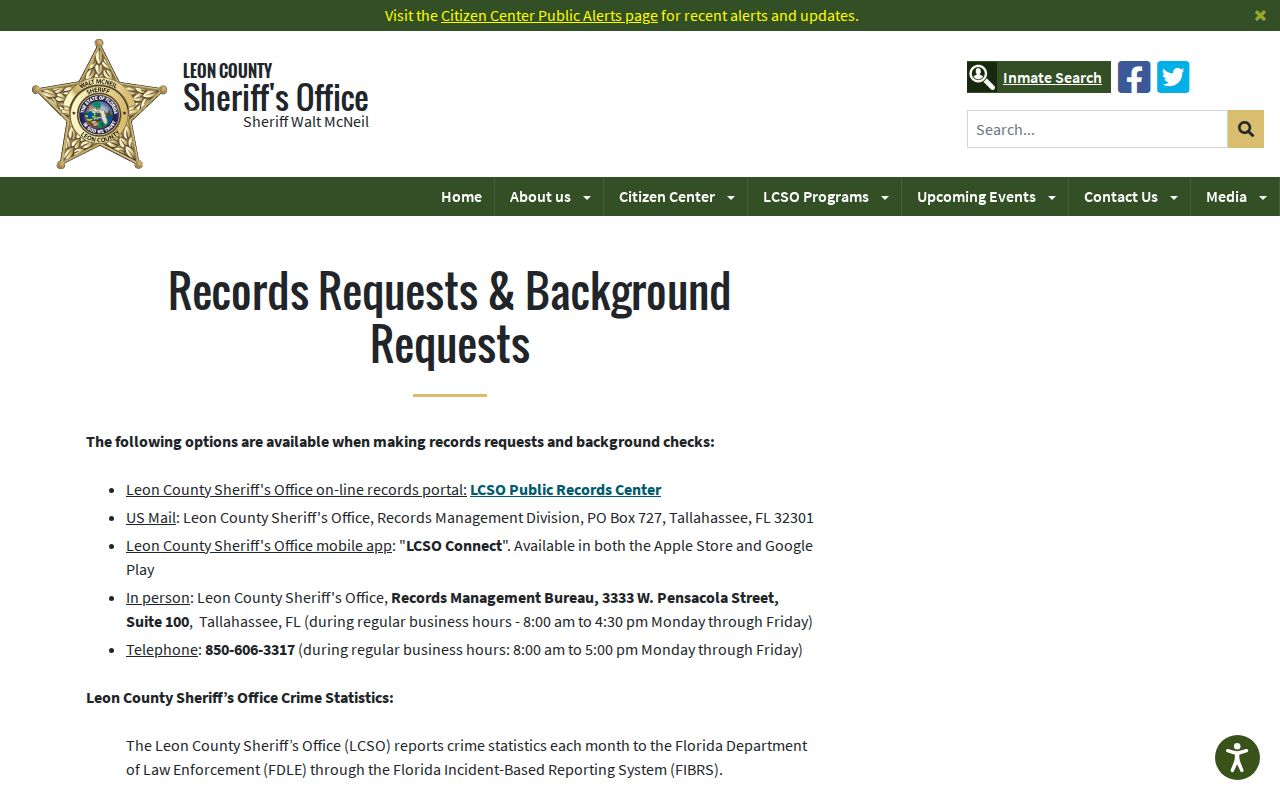
The page shown above routes a focused three-day release request to LCSO rather than presenting a public list that does not exist.
Confirm Leon Releases Beyond Roster
The Leon Clerk criminal docket can outlast the live jail row. Search the case for a release form, bond or first-appearance order, disposition, judgment, sentence, probation order, or later satisfaction entry. A court record explains the legal basis for release. It does not, by itself, record the minute the person completed LCDF processing.
Florida VINE supplies agency-fed status and event notices for participating records. Select LCDF when checking a local jail event, then read the exact custody status and event wording. A transfer alert means movement, not freedom. If the person entered FDC custody, use the state release search. If a federal agency took custody, use BOP and the federal docket. ICE's locator has its own scope and a no-result is not proof of release.
A durable three-day review pairs the jail timestamp with the court authority and any next-custodian result. The Leon County named-person release search is the better route when the goal is one person's full custody trail rather than a date-based cohort.
Leon Release Data Quirks
Leon's public search can show a Last Release Date even though the search is limited to people currently in custody. That column may reflect an earlier booking episode. An in-custody record can also use a placeholder date rather than a completed release. Read the In Jail? indicator and the tool's stated population before interpreting any date.
The retired Daily Booking Report had no photo and was never a full release archive. LCSO's official discontinuation notice ended its routine publication starting January 17, 2025. LCSO Connect materials describe inmate search, former daily booking access, detention information, alerts, and records requests, but they do not promise a Recent Releases tab or a 72-hour filter.
That combination makes records, court, and VINE the honest fallback. It also explains why a three-day page must preserve uncertainty instead of displaying a current roster under a new heading.
Note: Verify any app feature against current official LCSO materials because the original booking-report description predates the publication change.
Leon Release or Custody Transfer
LCDF may close its custody event after bond, recognizance, supervised pretrial release, authorized fine or purge payment, time served, or another written release authority. The person may also leave LCDF for FDC reception, another jurisdiction, treatment, Florida State Hospital, federal custody, or immigration custody. Both kinds of exits remove the person from the local roster.
- Community release
- The person leaves jail custody, though a criminal case or supervision conditions may remain active.
- Transfer
- LCDF custody ends because another agency or placement assumes control.
- Discharge
- A correctional term or supervision status ends as shown by the responsible agency's record.
- Current custody
- The person remains listed in the active system of the agency holding them.
Use the release method and destination to classify each event inside the 72-hour period. A simple roster absence cannot do that work.