
Leon County Release Records Explained
A release from the Leon County Detention Facility means LCSO has closed that custody event. It does not always mean the person walked free. Community release may follow bond, recognizance, supervised pretrial release, payment of an authorized fine or purge, time served, or other written authority. LCSO also moves people to the Florida Department of Corrections, another jurisdiction, treatment, Florida State Hospital, federal custody, or immigration custody. Those moves end the Leon County jail stay but begin or continue custody elsewhere.
The closed booking episode is therefore the key record. It ties the booking to the actual exit time, release method, legal authority, and, when public, the transfer destination. The live LCSO inmate search answers whether someone is listed in current custody. A missing name alone does not prove release. It can also reflect a transfer, delay, spelling mismatch, or a record outside LCSO.
Leon County Inmate Release Types
Local records use several terms for how custody ends. Each term points to a different next step, so it should be preserved exactly rather than reduced to the single word “released.” Court disposition and physical jail release are related, but they are not the same event.
| Release type | What it means | Best next record |
|---|---|---|
| Bond or recognizance | Jail custody ends while the criminal case remains open and conditions may apply. | LCDF release event and Leon Clerk docket |
| Supervised pretrial release | The person is in the community before disposition under a local court order. | Release form and Leon County pretrial office |
| Time served or expiration | The local custodial term ends, subject to any other hold. | Jail calculation, commitment, and release event |
| Probation, parole, or conditional release | Physical custody ends but correctional control continues. | County order, FDC supervision search, or FCOR order |
| Transfer | LCSO custody ends and another agency or placement takes control. | Transfer destination plus receiving-agency record |
| Dismissal or acquittal | The court resolves a charge, but the separate jail exit still needs confirmation. | Court disposition and LCDF event |
- Discharge
- The formal end of a custody or supervision term.
- Time served
- A sentence satisfied by time already spent in custody.
- Detainer
- A request or authority that can keep a person held for another agency.
- Expungement
- Court-ordered relief that restricts or removes qualifying records under Florida law.
Note: A transfer closes Leon County jail custody but does not establish that the person entered the community.
Leon County Release Record Fields
A useful request seeks the full booking and release event, not an undefined “inmate file.” Give the full name, an approximate booking date, and the LCSO SPN or booking number when known. Date of birth can help distinguish similar names when it is appropriate to provide it. Ask for the booking photo as a separate item because it may not be included with the event record.
| Field | What it shows |
|---|---|
| Full name and identifiers | The person tied to the booking episode, including SPN or booking number when recorded. |
| Booking date | The start of the specific LCDF custody episode. |
| Actual release date and time | When physical out-processing finished, not merely when a judge ruled or bond was paid. |
| Release method or authority | Bond, recognizance, pretrial order, time served, payment, transfer, or another lawful basis. |
| Charges and case numbers | The court matters connected to that booking, subject to lawful redaction. |
| Hold or transfer destination | Whether another agency took custody and where the trail continues, when the field is public. |
| Property and account processing | The closing steps for personal property and available account funds. |
Does a Last Release Date always prove a new release? No. LCSO’s current results may carry a Last Release Date field, and an in-custody record can display the placeholder date 01/01/0001. That sentinel value is not an actual release and must not be reported as one.
Request Leon County Release Records
The LCSO Records and Reports page links to the GovQA portal and lists mail, telephone, app, and in-person channels. Records Management is at 3333 West Pensacola Street, Suite 100, Tallahassee, FL 32304. The phone is 850-606-3317. In-person hours are Monday through Friday, 8 a.m. to 4:30 p.m.; telephone hours run to 5 p.m. Mail may be sent to LCSO, P.O. Box 727, Tallahassee, FL 32301.
- Identify the person, approximate booking date, and SPN or case number if known.
- Ask for the booking and release record, including actual release date and time, method or legal authority, and public transfer destination.
- Request the booking photograph separately if it is needed to confirm identity.
- Ask for electronic copies and a cost estimate before special-service charges are incurred.
- If material is withheld, ask for the specific exemption and a written explanation while requesting the nonexempt remainder.
Florida Statute §119.07 allows inspection and copying under reasonable conditions. Paper fees may be up to 15 cents for a one-sided page, plus 5 cents for a two-sided copy. Other media may be billed at actual cost, and extensive staff or technology work can bring a reasonable special-service charge. Florida does not set one fixed response deadline for every request. The agency must acknowledge promptly and respond in good faith.
The official records-request screen shows where a closed Leon County release event can be requested after the roster no longer carries it.
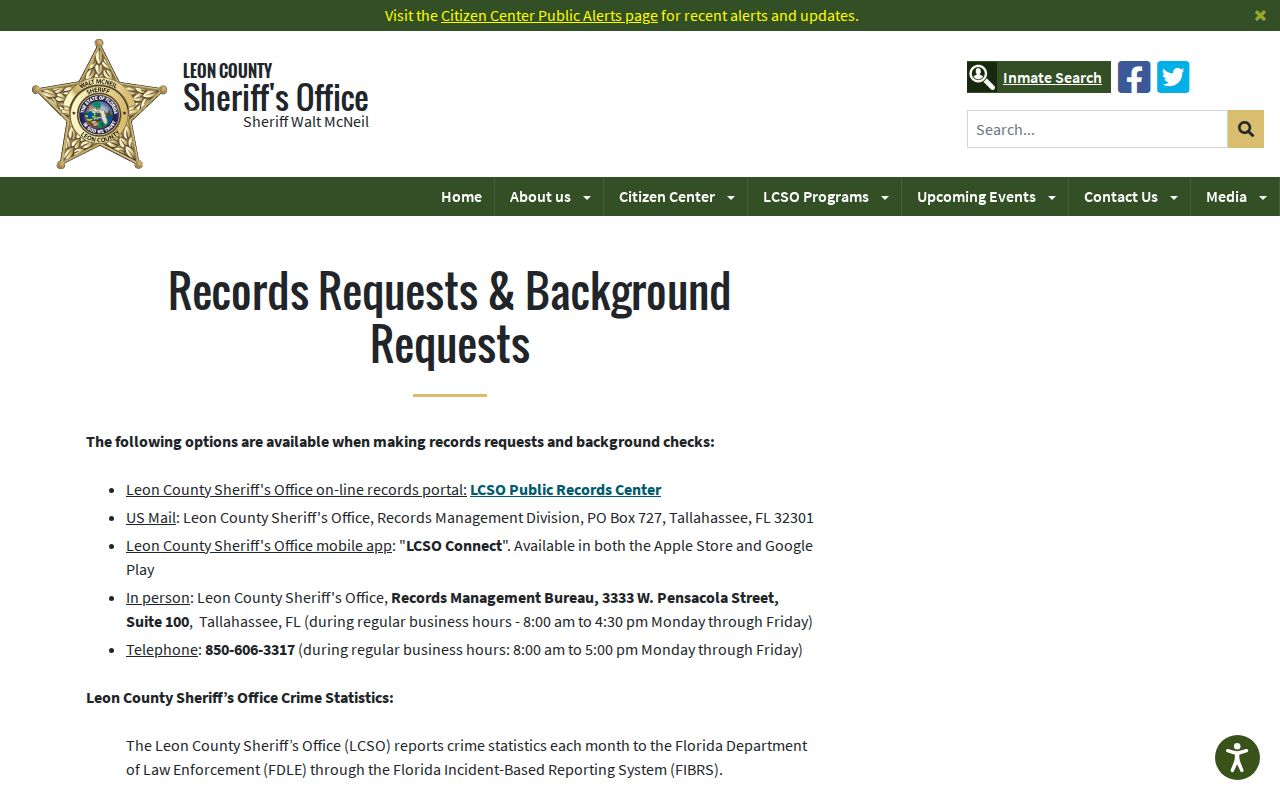
This channel is the best local fallback when no public feed or current-roster result answers the release question.
Leon County Release Record Limits
Florida Chapter 119 broadly covers records and photographs made or received in official business. Basic arrest facts can remain available even when active investigative content is exempt. Yet release access is not unlimited. Confidential victim data, active intelligence, protected juvenile material, medical information, sealed or expunged records, and other exempt personal details may be withheld or redacted under §119.071.
No official duration was found for displaying a released person in the live LCSO search. Florida’s GS2 schedule discusses retention for commitment and release lists, booking records, and inmate incarceration records, but a retention schedule does not create an online Leon County archive. For old events, request the record and check the court docket. A sealed or expunged case may disappear from public view, but that later change does not alter the historical release method or convert a transfer into community release.
Note: Juvenile departures require lawful DJJ, guardian, counsel, or juvenile-court channels, not the adult inmate search.
When Leon County Releases Inmates
LCDF does not promise a set gate time. The 2024 inmate handbook says sentenced people may leave at any time on the scheduled date. Other releases start after staff receive written legal authority. A judge’s ruling, clerk entry, or bond payment can therefore precede the actual exit.
Normal out-processing is estimated at about 45 to 60 minutes. Court or clerk paperwork and checks for other wants or holds can add time. The releasing event, not the first legal step, is the physical confirmation. For a same-day operational question, LCDF’s releasing office is 850-606-3526. A durable answer still comes from the dated event record.
Transit After Leon County Release
Getting away from LCDF can be planned with a current transit check. StarMetro’s operating office at 555 Appleyard Drive is next to the jail at 535 Appleyard Drive. The city’s weekday Forest Route names “StarMetro Offices” as a major stop. The broader route page should be checked for live service details and detours.
This is a nearby public transportation option, not a promise of service at the exact moment release finishes. Because LCDF sets no fixed exit time, a ride plan should account for paperwork and hold checks. No official exit door, family waiting area, rideshare rule, or weekend shortcut was found, so those details should be confirmed with the facility.
Note: Check current StarMetro service after the release event because route conditions can change without matching LCDF processing time.
Leon County Pretrial Release Costs
Leon Supervised Pretrial Release places an officer in LCDF around the clock and attends First Appearance every day of the year. A judge may order release into supervision with or without a money bond. Conditions can include curfew, tests, treatment, or electronic monitoring. This status is release before the case is decided, not sentence completion.
The county identifies a $40 administrative fee plus costs tied to conditions. The court order controls what applies in an individual case. Leon County pretrial staff can confirm an assignment at 850-606-5700 during published weekday office hours. County probation is a separate local channel, while FDC Community Corrections handles state supervision.
Note: Pretrial release keeps the criminal case open and must not be described as a final sentence discharge.
Leon County Release Counts
LCSO annual reports give context without claiming to show a live population. Each figure describes operations in a named year, and releases are events rather than a count of unique people.
The 2023 LCSO Annual Report also describes Booking/Releasing and Court Services functions. The older 2020 report counted 6,556 bookings and an average population of 965. None of these dated totals proves whether one named person was released.
Property After Leon County Release
LCDF out-processing includes the return of personal property and account funds. The handbook says the person receives $5 in cash and the rest of the commissary balance on a debit card. If the card system is unavailable, a check is used. Transfer procedures can differ because the person may move directly into another agency’s custody.
A person in custody may authorize someone else to collect property before release. The form takes about 24 hours to reach the Property Office, and the recipient should call first and bring photo identification. An authorization becomes void after 30 days. These steps concern property handling and do not establish the time or legal basis of release.
Find Leon County Released Inmates
The most reliable search begins by identifying the last custodian. A recent local arrest by LCSO, Tallahassee Police, campus police, or another Leon agency usually begins at LCDF because it is the central adult booking facility. A Florida prison sentence belongs in FDC. Federal custody belongs in BOP or the federal docket. Youth records require the separate DJJ and juvenile-court process.
- Search LCSO to answer only whether the person is currently listed at LCDF.
- If absent, ask LCSO for the closed booking and release event, including destination for a transfer.
- Read the Leon Clerk criminal docket for the release form, bond order, judgment, sentence, or disposition.
- Check Leon pretrial, county probation, or FDC supervision when a court order points to that status.
- For state prison, use FDC Inmate Release Search by DC number when possible.
- Use Florida VINE for participating-agency status and alerts, then confirm the event with the custodian.
- Continue into BOP, ICE, another jail, or another agency if the LCDF record shows a transfer.
There is no current official Leon County 24-hour or 72-hour released-only feed. LCSO ended web and social publication of its Daily Booking Report in January 2025. That old report covered people booked on one date, not everyone released in a rolling period. The current roster must not be relabeled as a release list.
Florida Search for Leon Releases
The FDC Corrections Offender Network separates current inmates, released inmates, supervised people, and absconders. For a person released or scheduled for release from Florida prison, select Inmate Release Information Search. This database covers felony offenders sentenced to state prison or state supervision. It does not cover a person sentenced only to Leon County jail or county probation.
- DC number: the preferred six-character identifier, all numbers or one letter followed by five numbers.
- Name: first and last name fields use begins-with matching.
- Aliases: an option when the committed name may differ.
- Photo settings: results can suppress photos or limit the list to records with photos.
- Detail check: compare the DC number, identity, photo, commitment facts, status, and exact date label.
The release database updates nightly and includes people already released or scheduled for release. A future date is not a completed event. Florida also uses “tentative release date” for a sentence calculation under §944.275. Preserve the exact field label. If the person is now under state supervision, run the same DC number in Supervised Population.
The official FDC Inmate Release Search shows the state-specific form used for a Leon County case that became an FDC commitment.
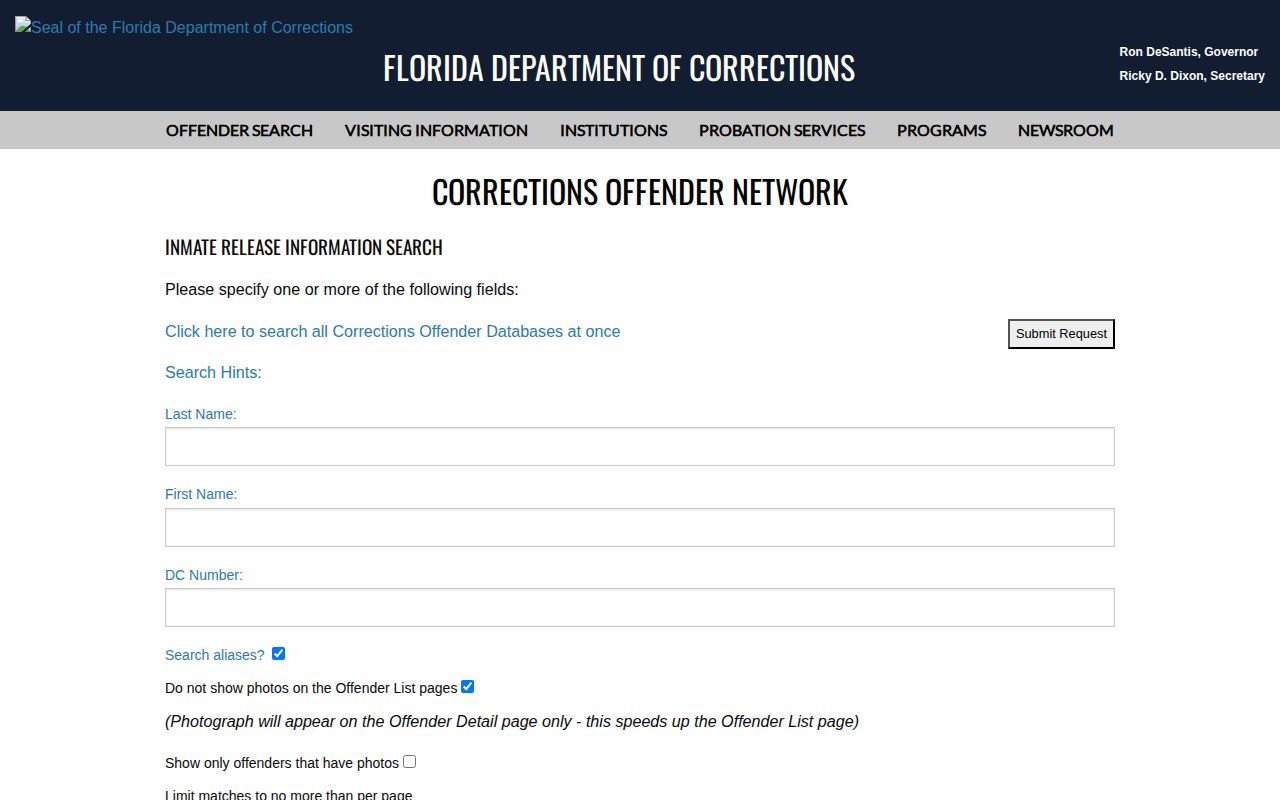
Its results must be matched by identifier and record details because a name alone can identify the wrong person.
Note: A future FDC date is a projection, while a past release entry must still be read with its status.
Leon Court Release Form Search
The Leon Clerk says its criminal case file receives arrest papers and any release form sent by LCSO. Public documents are added to the progress docket and imaged when allowed. This makes the court file a long-lived companion to the jail event after the live roster drops the person. Search both CF felony and MM misdemeanor case types rather than guessing from a charge label.
The Leon Clerk court-records gateway can lead to charges, progress entries, disposition, plea, judgment, sentence, bond or release orders, probation entries, and later termination. Read events in date order. A disposition or “closed” status does not prove the minute physical release finished, while a bond release can occur long before final disposition.
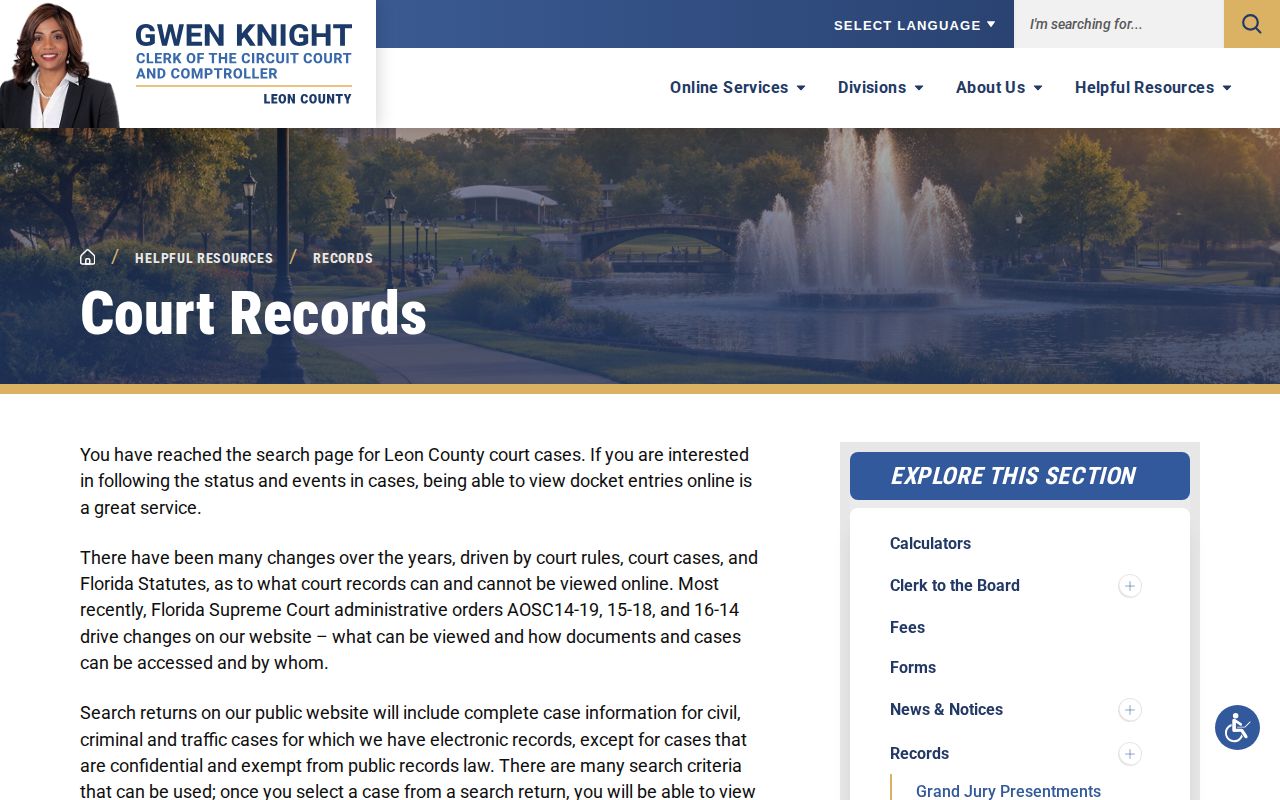
Older docket entries may lack images. The Clerk’s request-document process may charge $1 per page for a scanned or paper court document with no online image.
Leon Release Supervision and RISE
Post-release control depends on the order. Leon Supervised Pretrial Release covers defendants in the community before disposition. County probation is local. FDC Community Corrections supervises state probation and related statuses, while the Florida Commission on Offender Review makes parole and certain conditional-release decisions. Parole is mainly relevant to legacy and defined statutory cases, not most modern Florida felony sentences.
LCSO’s Releasing Section may coordinate probation or parole GPS attachment, registration duties, and victim contacts before a person leaves. Those steps explain why physical release can follow the first court action. Verify the resulting status in the local order, FDC Supervised Population search, or final FCOR action. More detail appears in the Leon County Parole & Probation record path.
The LCSO RISE Center serves people released from LCDF, FDC, DJJ, and BOP. Its cross-system navigation includes identification documents, legal and health access, treatment connections, financial counseling, and family reunification. The current contact number is 850-606-3172.
Note: Supervision means a person is outside confinement but remains subject to conditions and official oversight.
Leon Release Alerts and Transfers
Florida VINELink provides agency-fed custody status and event registration for LCDF, Florida county detention facilities, FDC prisons, and DJJ. It can send notice of release, transfer, escape, work-release placement, return to custody, or death. Data may lag, so an alert is secondary evidence rather than a certified permanent record. A transfer alert must not be called community release.
For federal custody, use the BOP Inmate Locator. A past date with “Released” or “Not in BOP Custody” confirms that BOP custody ended as shown. It does not rule out supervised release, another warrant, or custody elsewhere. Federal pretrial movement may also require the Northern District docket and U.S. Marshals records because USMS has no comparable public released-prisoner locator.
If the LCDF event shows immigration transfer, the ICE Online Detainee Locator covers current ICE detention and some people released from ICE custody within the prior 60 days. A no-result can reflect release, transfer, delay, safety limits, or unmatched input. It is not proof of release or removal.
Note: Custody alerts are useful for timing, but the originating agency’s event record remains the durable release confirmation.
Compare Leon County Release Sources
Use the source tied to the custody type. One portal cannot reliably answer every Leon County release question.
| Situation | Correct source | What the result means |
|---|---|---|
| Still at LCDF | LCSO current inmate search | A hit confirms listed current custody; a miss needs more checks. |
| Released or transferred from LCDF | LCSO closed release event plus Clerk docket | The event gives actual time and method; the court file explains authority. |
| Released from Florida prison | FDC Inmate Release Search | A past release status/date concerns state custody, not a short county-jail stay. |
| Under supervision | Leon pretrial/probation order or FDC supervised search | The person may be in the community but remains under official control. |
| Federal custody ended | BOP locator and federal docket | BOP release ends BOP custody only. |
| Possible immigration handoff | LCDF transfer record and ICE ODLS | Departure from LCDF may be continued custody, not freedom. |
Leon County Release Facilities
Facility type determines the record path. The adult county jail, state community release program, federal complex, and juvenile center do not share one roster or one definition of release.
- Leon County Detention Facility: community release or transfer is confirmed by the LCSO event and court record.
- Tallahassee Community Release Center: placement remains FDC custody until the FDC record shows release, supervision, or final discharge.
- Federal Correctional Institution Tallahassee: BOP release data controls, with federal records used for added confirmation.
- Federal Detention Center Tallahassee: court, USMS, and BOP sources distinguish release from federal transfer.
- Leon Regional Juvenile Detention Center: authorized guardians, counsel, juvenile court, and DJJ handle confidential youth information.
The community release center’s current operator and site relationship should be verified because official FDC sources do not conclusively resolve whether separate Tallahassee and SHISA descriptions refer to the same present program.